
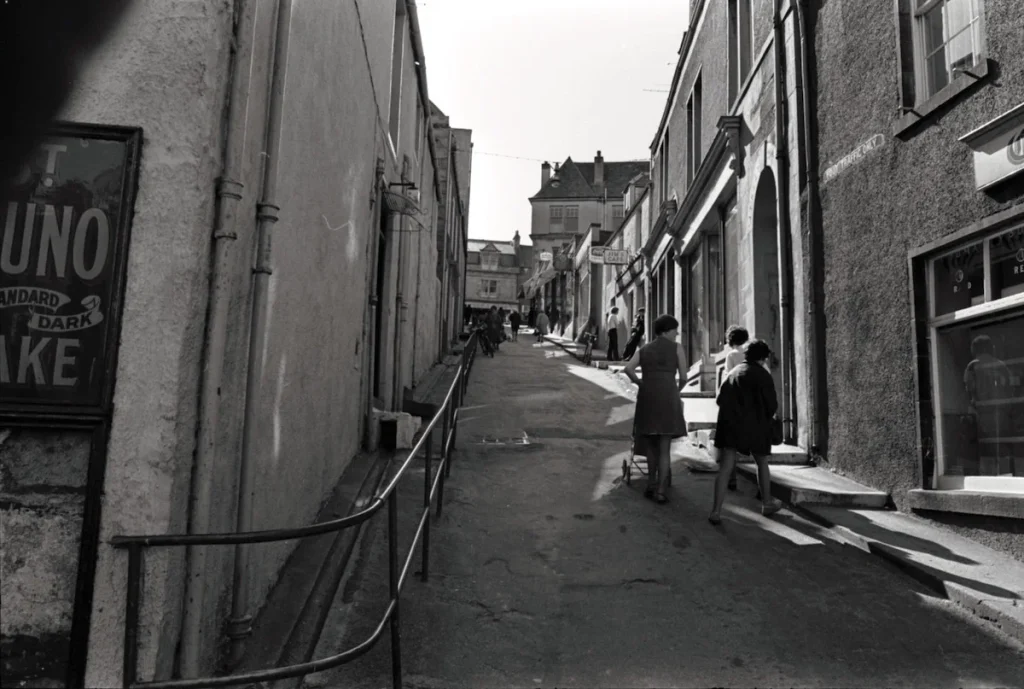
# Illegitimacy in the Scottish Countryside: A Way of Life
It was late 1953 when journalist Liam Regan found himself standing in a kitchen on the coast of Banffshire, in northeast Scotland. This was farming and fishing country, where the nearest city, Aberdeen, lay some 50 miles away. Whisky distilleries dotted the landscape. Regan was interviewing a “middle aged housewife” when her adult daughter walked in. He addressed the older woman as “Mrs” – and she promptly corrected him. She was “no merrit,” she said. Not married.
Nor was she unusual.
Over the next two days, local men pointed out other unmarried mothers in their communities, some with astonishing numbers of children. “She’s got ten children and she’s single,” one informant said, nodding toward a “pleasant faced” young woman passing by on the street.
The government statistics backed up the anecdotes. In Banffshire, 75 “illegitimate” live births were recorded in 1951 – a rate of 8.5 per hundred. Neighbouring Morayshire and Nairnshire reported 73 such births in 1952, a rate of 6.9, compared to the national average of 5.2. Though only marginally above the national figure, it was enough to warrant an investigative trip.
Searching for Explanations
Locals offered Regan theories ranging from the unlikely to the absurd. Was it caused by a “lack of town amenities”? The lingering influence of Vikings, a thousand years after their raids? The fertility of the soil? One clergyman suggested, “with a smile,” that the bracing local air might be responsible.
Regan himself reached a different conclusion: illegitimacy was “not so much a problem as a way of life.”
His exposé ran in the Glasgow tabloid Sunday Mail under the headline: “Illegitimacy is taken for granted in Banffshire.” It was sensationalist fare, complete with subheadings like “Shocking case” and “North’s bad record.” Masquerading as moralistic social investigation, it was really a prurient muckraking operation designed to shock the public.
Regan’s “surprise” was disingenuous. He had travelled to Banff knowing its reputation, having previously visited Wigtownshire in southeast Scotland for the same story. There too, unusually high numbers of births to unwed mothers had long been a feature of rural life.
Historical Roots
The phenomenon had vexed moral guardians for generations. Writing in 1980, historian Kenneth M. Boyd noted how 19th-century church moralists, particularly Free Church minister James Begg, had urged action against a “moral epidemic” of “bastards” in the countryside, fearing the “contagion” might spread to cities. Begg partly blamed the mixed sleeping accommodation in farm workers’ bothies.
More recently, historian Tanya Cheadle has argued for the existence of “alternative moralities” among marginal groups in 19th-century Scotland, including rural farming and fishing communities, where pre-marital sexual intimacies could be tolerated or even encouraged as a test of fertility. Andrew Blaikie’s work similarly shows that in the rural northeast, there was little or no stigma attached to unmarried motherhood.
Beverly McFarlane, a retired nurse who grew up in Forfar in the early 1960s, confirmed this. Much of her sex education came from “eavesdropping on the conversations of adults.” In one such conversation, a local “granny” – a family friend raising her unmarried daughter’s child – declared that “a lassie that could not give her man bairns was nae use on a farm.” The implication was clear: any prospective husband needed a policy of “try before you buy.”
“There was general assent at this,” Beverly recalled, “with another neighbour saying that ‘it was fun trying’ – which I did not understand at the time. There was no sense of affront in that circle, and these women were considered very respectable, attending church on Sundays.”
The Urban Gaze
Illegitimacy in the countryside was newsworthy in the 1950s because it seemed like an aberration to most of the population. Mainstream morality, derived from the Church, insisted on tightly regulated female respectability, pre-marital chastity, and fidelity within marriage. Scotland was a pious country, and moral vigilance was in fashion, fuelled by a large-scale Christian revival after the Second World War.
But unwed mothers were also seen through a class lens. In 1955, one “Mr McLennan,” possibly a social worker, addressed the annual general meeting of the Scottish Council for the Unmarried Mother and Her Child (SCUMAC), asserting that “the problem of the unmarried mother is both moral and spiritual.”
Medical sociologist Barbara Thompson investigated births registered to unmarried mothers in Aberdeen in the mid-1950s and found a clear association between unmarried motherhood, poverty, and manual labour. “Illegitimacy and pre-nuptial conception occur predominantly in the lower social classes,” she concluded, with the highest rates among workers in the fish processing industry.
Teenage Tales
Regan’s November 1953 article relied heavily on anonymous male informers and presented small-town gossip as fact. A visit to Elgin, the county town of Morayshire, yielded allegations about teenage girls’ behaviour. One source assured Regan that some girls were highly sexually active with multiple partners. The journalist claimed to have witnessed “young girls and lads hanging about outside café windows, larking about playfully, then gradually disappearing in pairs.”
One source from the coastal village of Cullen told Regan a “shocking tale”: when Glasgow schoolboys were living in the district, they were “quite embarrassed by the unduly affectionate attentions of some young ladies – a number of whom were little more than girls.”
Prior to publication, Regan’s exposés were advertised in local newspapers with an illustration of the “problem girl” – a popular stereotype – wearing heavy makeup while holding a baby.
Yet Regan’s article contained a significant contradiction. While he sought to present the high number of unmarried mothers as outrageous, it was, nonetheless, socially acceptable for working-class people in these areas.
The Long 1960s
By the mid-1960s, unmarried motherhood in rural northeast Scotland had stopped being newsworthy. The reason? Illegitimacy was rising in urban Scotland. Commentators lost interest in the fishing villages of Banffshire.
From the late 1950s, the national rate of births to lone mothers increased. In February 1965, Glasgow’s Daily Record reported a “Crisis of the Unmarried Mothers” on its front page, noting that illegitimacy in the city had reached 7.1 per cent. City councillor Ellen McCulloch voiced concern about television broadcasts, which she believed were influencing teenage behaviour. She requested that both available channels “play down the sex angle.”
By October 1966, Glasgow’s rate had reached 7.7 per cent. The city’s medical officer of health, William Horne, commented that “the illegitimate birth rate has been rising all over the country and reflects present day attitudes to the accepted moral code.”
The Researchers Arrive
Raymond Illsley, appointed the first Professor of Sociology at the University of Aberdeen in 1964, analysed the statistics with colleague Derek Gill. Their December 1968 paper, “Changing Trends in Illegitimacy,” showed that increased birth rates to unwed mothers in cities had, since the late 1950s, outstripped those in rural areas. In Scottish cities, illegitimate births had increased from 5.5 per cent in 1959 to 9 per cent in 1964.
They also showed that unwed mothers were becoming younger. “The spreading ratios of illegitimacy have travelled the same geographical routes from south to north, from town to country,” they wrote, “as the teenage culture associated with Carnaby Street, commercial pop music and the mini-skirt.”
In May 1970, an article in the Aberdeen Evening Express titled “Illegitimacy rate is not class conscious” emphasised their finding that pregnancies were “markedly increasing” among unmarried women under 25, and had “not been as before, a characteristic of those from poorer homes.”
The Student Question
Illsley and Gill highlighted the danger of pregnancy to female university students, contributing to a re-imagining of illegitimacy from a working-class phenomenon into a potential disaster for the middle class. “The college or university student has shown the same increased susceptibility to pre and extra-marital conception as the petrol pump attendant or the prawn peeler,” they wrote.
The sexual behaviour of students was already in the spotlight. In early 1968, socialist student activists at the University of Edinburgh clashed with Malcolm Muggeridge, a journalist turned religious moralist who had been elected rector. Responding to rising unplanned pregnancies, the activists demanded liberalised access to the oral contraceptive pill, which was then restricted to married women.
Muggeridge equated contraception with recreational drug use and nuclear warfare. “How sad, how macabre and funny it is that all they put forward should be a demand for ‘pot and pills’,” he said. Life, he declared, was not about “drugged stupefaction and casual sexual relations.”
Modern Times
During the early 1970s, societal changes further eclipsed the archaic sexual culture of rural northeast Scotland. The national illegitimacy rate continued to rise, but the overall birth rate began dropping from 1969, likely due to increased availability of the pill, which became available to single women on prescription from 1974. The Abortion Act of 1967, implemented the following year, allowed termination under strict conditions.
In August 1974, the Daily Record reported on the latest statistics with the subheading: “Love Baby Boom in the Sexy Seventies.” The article highlighted high rates in Aberdeen, Glasgow, and Dundee. Dr T. Scott, Glasgow’s chief medical officer, commented: “The general increase in illegitimacy is due to the general change in the pattern of life. People are not as restrained as they used to be.”
His colleague in Dundee believed that “in many cases, pregnancies are wanted by couples who aren’t married but are living together as husband and wife.”
The End of Stigma
The turn of the 1970s saw progressive campaigners assault the concept of illegitimacy itself. The Legitimation (Scotland) Act 1968 began tackling stigma by legitimising children of parents who subsequently married. The Law Reform (Scotland) Act 1968 removed legal disabilities in inheritance law for children whose parents had been unmarried.
In 1973, the Scottish Council for the Unmarried Mother and Her Child changed its name to the Scottish Council for Single Parents, citing a desire to “eradicate the stigma historically attached to ‘illegitimate’ and ‘unmarried’.” (It may also have been because their acronym, SCUMAC, was being colloquially rendered as “scum.”)
The newly renamed organisation had already retreated from the overtly religious language of the 1950s. Its 1969 report attributed declining use of its Mother and Baby Homes to more mothers remaining at home and an emboldened distrust of authority.
And so the rural, working-class culture of northeast Scotland, with its broad acceptance of illegitimacy that had excited media attention in the 1950s, no longer seemed exceptional. In fact, it almost seemed ahead of its time.
Relevant
Als Petrus über das Wasser ging
Der Generalstreik, der alles veränderte
Hunde und ihre Halsbänder im antiken Griechenland
Erstflug der Spitfire
Achaiischer Bund
Erster Kreuzzug: Ursachen, Verlauf, Folgen
Der Gott, der weint
Rezension: „Der Preis des Sieges“ von N.A.M. Rodger